
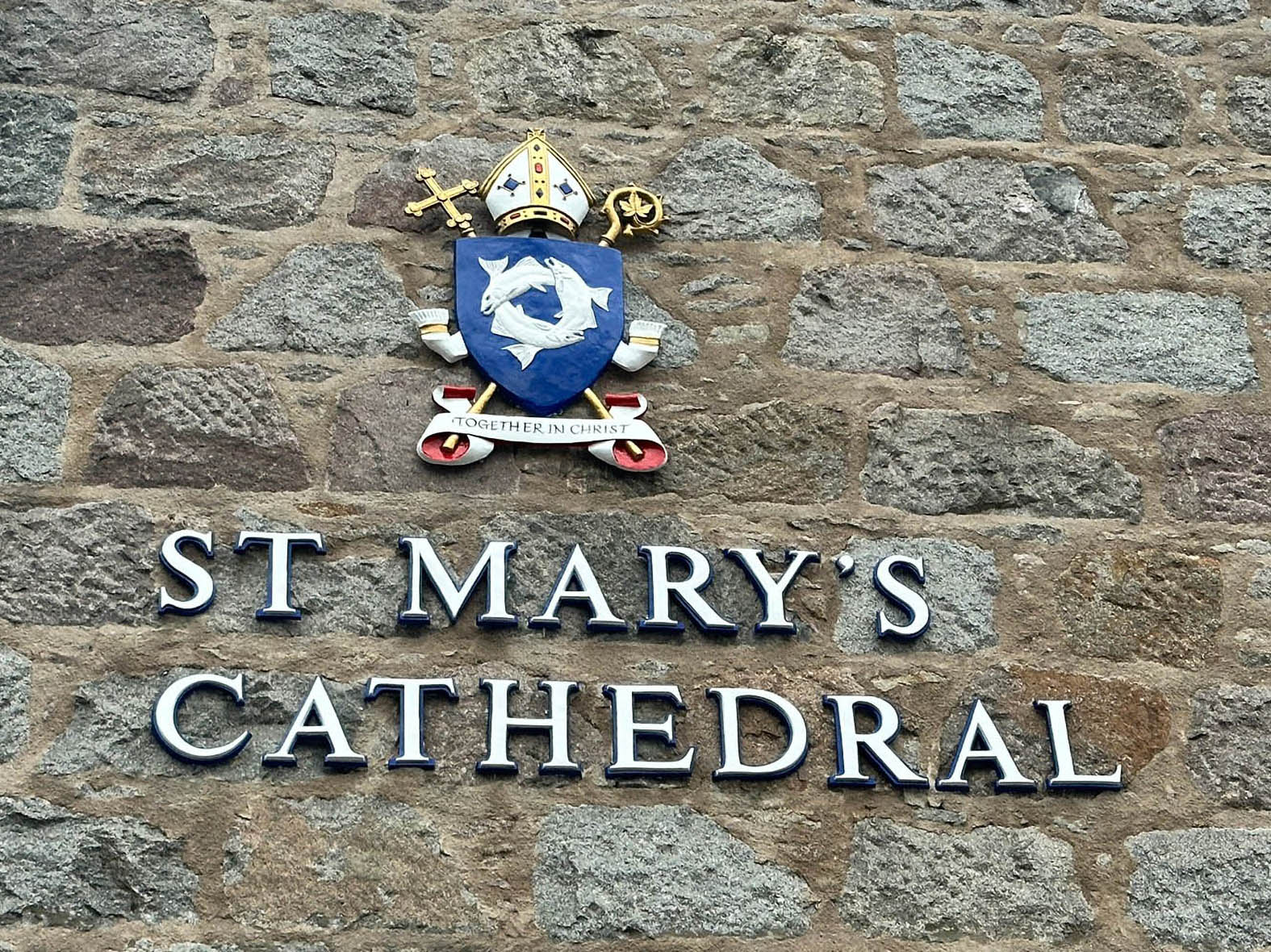
After nearly one year of planning, a week-long restoration project transformed the bishop’s coat of arms and St Mary’s Cathedral’s dimensional letters.
Decades of discolouration were sanded away. Multiple coats were then carefully hand painted in situ for a protective, gleaming finish. At last, the vibrant sign is clearly visible facing passersby in the city’s main Union Street.
The brightened sign restoration not only improves the cathedral’s presence in Aberdeen city centre. It conveys the cathedral’s open and approachable personality.
In summer 2024, Steven Coleman emailed me with his extraordinary enquiry. Steven is the operations manager for St Mary’s Cathedral. He’s responsible for the building’s maintenance. With a remit covering countless aspects of construction, including specialist processes such as signage refurbishment, Steven sought my advice.
We exchanged e-mails before eventually speaking on the phone. I’d already studied the cathedral’s exterior photos on Google Maps and gained an understanding of the wall sign’s locality. At this stage, my thoughts focused on how to best access the height of the sign, as well as the duration of the hand painting process. I was intrigued.
St Mary’s Cathedral, tucked away in Huntly Street, is a hidden gem. As the principal Roman Catholic cathedral in the city, it serves as the central place of worship for the Catholic Diocese of Aberdeen. The Gothic Revival building is the seat of the Bishop of Aberdeen. Inside, beautiful works of art are behind the altar, and a working bell tower chimes across Aberdeen’s city centre skyline.
The cathedral feels welcoming. It’s a magnificent but sadly overlooked building. The purpose of highlighting the wall sign facing bustling Union Street is to encourage visitors towards the cathedral entrance.
In Steven’s original e-mail, he asked me if I was interested in providing my quote to refurbish the sign. Following an exchange of e-mails that same day, I replied in the evening with my indicative quote. There were many issues to clarify before I could calculate the estimated labour and materials’ accurate costs.
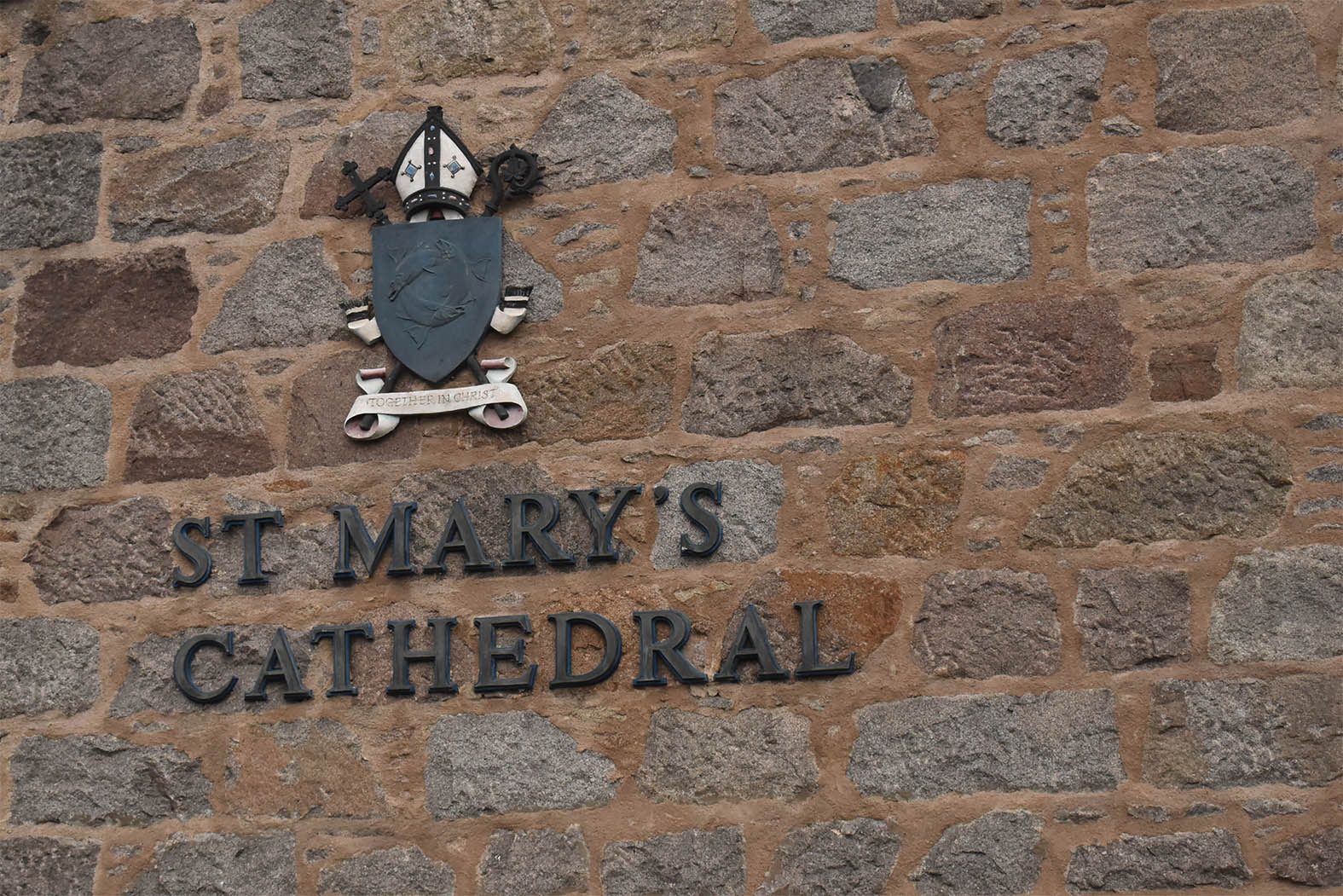
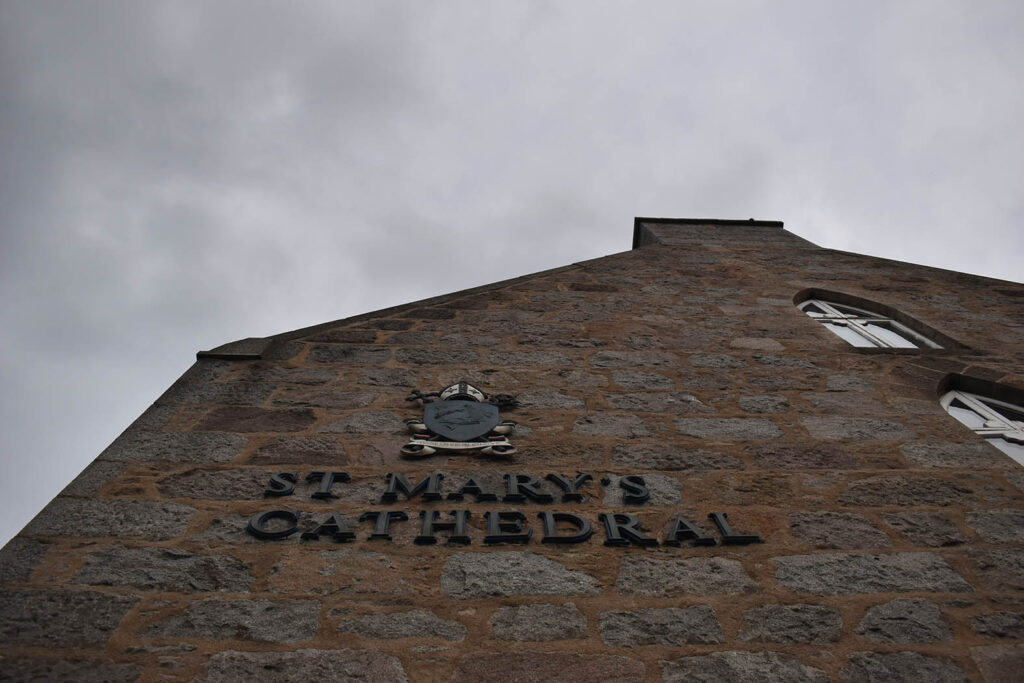
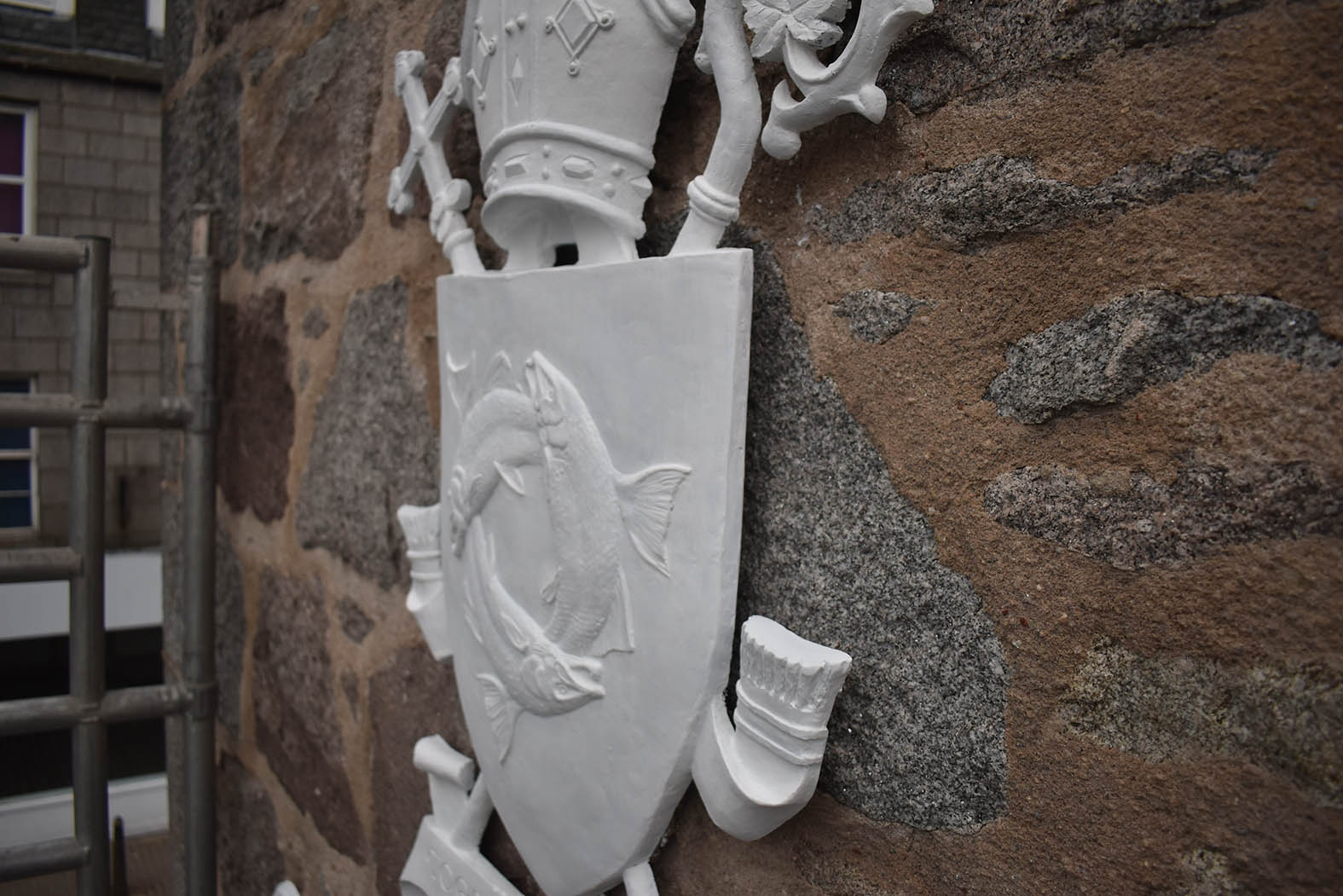
The sign is decades old. No one knows how old. Comprised of the bishop’s coat of arms above two adjoined layers of built up letters, the protruding letters’ faces are edged with a slightly thicker, chiselled outline. Clearly, the three dimensional letters were expertly manufactured and made to last.
We also didn’t know what material was used to make the curved-edged, moulded coat of arms and angled-edged, built-up letters. Understanding what the sign was made of was the crucial first stage in planning how to prepare and coat the signs’ surfaces.
Determining the correct primer to coat the unknown surfaces presented questions for the colour and finish of the restored sign. In turn, the finish would influence the coatings’ durability as well as how to practically maintain the sign in the coming years.
I also asked Steven to confirm if planning consent was necessary for the sign’s restoration, as well as street working permits required by Aberdeen’s local authority.
With several parties to consult before confirming anything, I suspected the seasons would change before a plan of works could be established. If the signs couldn’t be removed from the wall, I urged Steven to consider warmer temperatures for exterior painting in Aberdeen.
Over the coming weeks, Steven informed me of planned masonry maintenance surrounding the wall sign. He’d ask the stonemasons to confirm what the signs were made of and if they could be removed from the wall.
With no visible fixings, I suspected the signs were installed using a common method of rods attached to the backs of the coat of arms and built ups letters. The rods are sunk into holes drilled in the wall and secured with cement. I also doubted the new information that the signs were made of plastic.
In October 2024, Steven visited me and we met for the first time. We chose paint colours to match the Diocese coat of arms closely. We discussed the hand painted sign’s minutiae, as well as some heavier topics, before agreeing to meet again early in 2025.
In the first week of January 2025, I was working thirty miles north west of Aberdeen. After one overnight stay, I drove south into Aberdeen city centre and found Huntly Street. Steven met me at the cathedral’s large gable wall as I was unloading my two part ladder.
With the ladder extended as high as it would safely go, I climbed up the rungs for a closer look at the built ups’ fixings. Through the tight gaps between the backs of the letters and the cement dividing the granite blocks, I saw what appeared to be circular steel rods anchoring each letter inside the wall.
My outstretched arm and tapping of my finger indicated the sound of alloy. I guessed brass or copper due to the verdigris colouration of the letters and coat of arms. Steven and I spoke briefly before getting out of the cold for his guided tour. It was a treat and an honour to learn more about the cathedral before climbing the bell tower stairs and ringing the cathedral bell.
Elated from my amazing experience and mulling over the project, I drove home to Dundee.
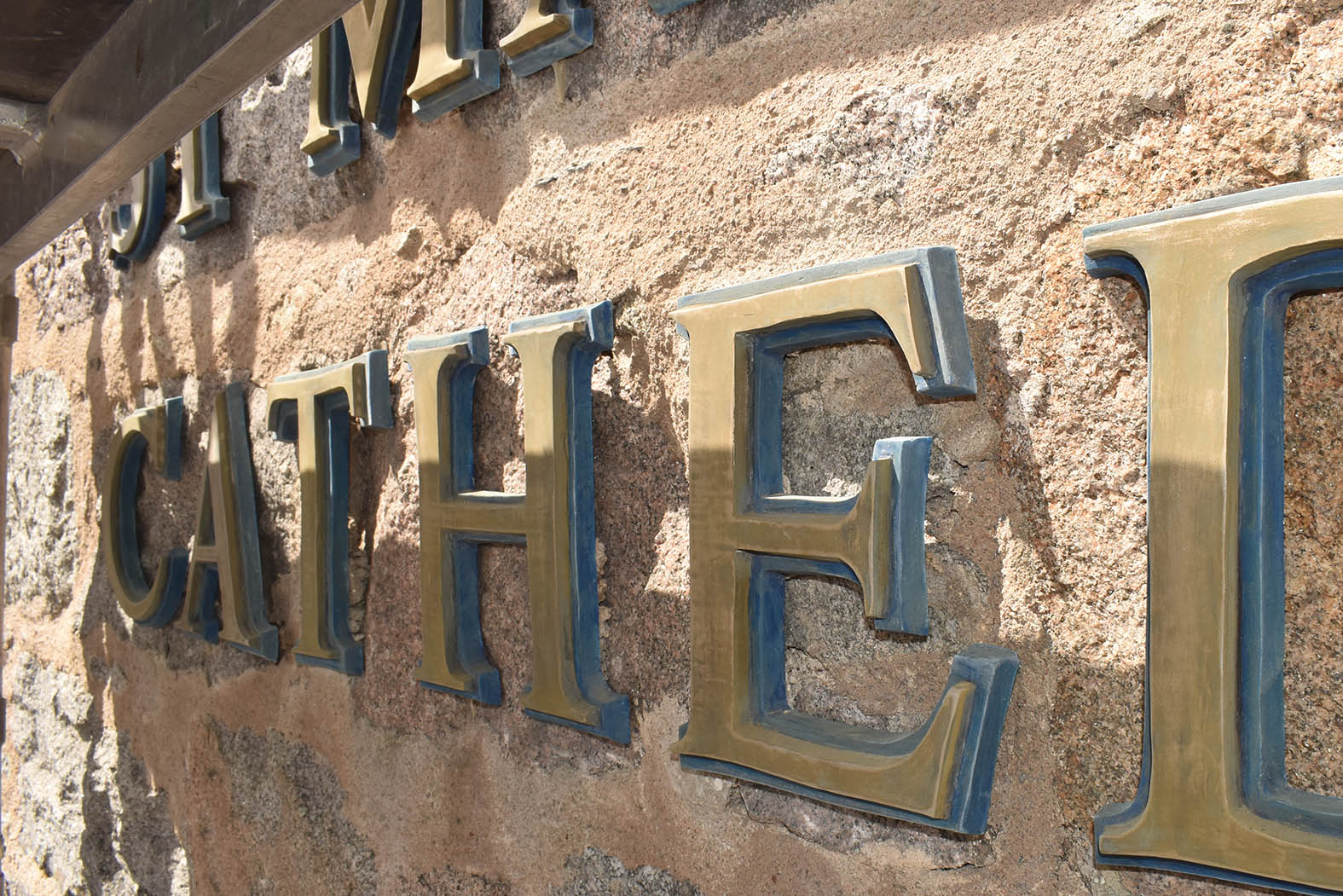
Two days later, I emailed a detailed itinerary explaining when and what would happen over the course of restoring the sign. I included my quote and lead time, advising to schedule work for spring 2025. Steven approved my quote a few days later, and we agreed to keep in touch to organise the scaffold tower.
Early on a Monday in late April 2025, I drove to Aberdeen. Steven was in Glasgow and had previously arranged for a scaffold tower to be delivered to the cathedral hall. The scaffold was donated by a member of the congregation.
Unfortunately, the scaffold was unsuitable for working at the necessary height. The project was postponed. We discussed an alternative, safer tower scaffold as well as access to the neighbouring supermarket car park.
At 7:30am on 23rd June 2025, I arrived again at the cathedral. I was raring to go.
Steven had hired a scaffold tower which was inside the cathedral hall, ready for assembly. I began carrying all the poles and platforms outside when Liam Sharkey pulled up in his pick-up. Liam is a member of the cathedral congregation and a bridge engineer. Liam’s assistance was invaluable.
We were halfway through building the tower when we realised a vital diagonal pole was missing. Following a quick phone call to the scaffold company, Liam drove off to collect the remaining part to allow us to build higher. I waited on the ground, in the drizzle, contemplating the week ahead.
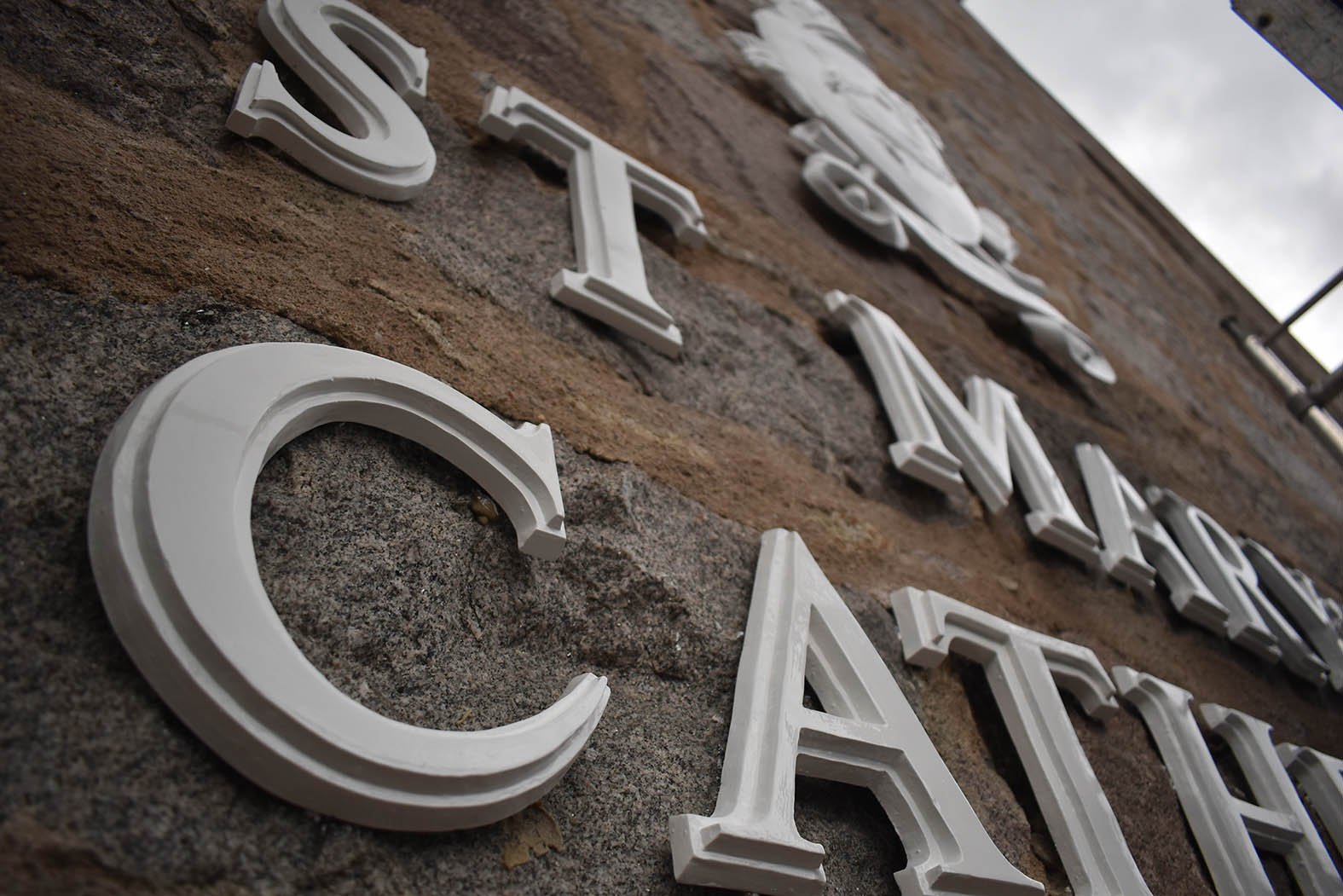
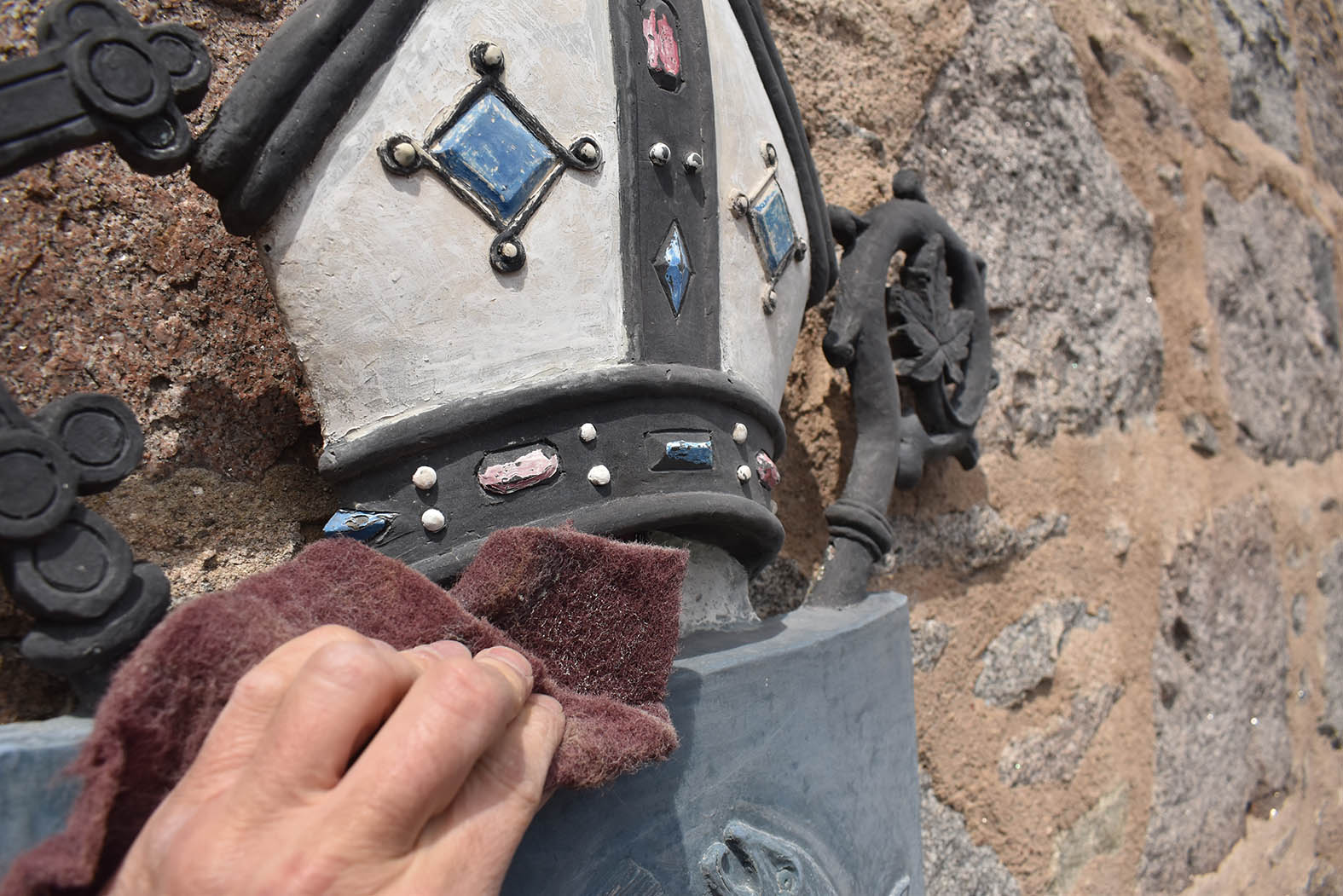
After Liam’s return, the first stage of refurbishment went rapidly. I began by thoroughly degreasing the coat of arms and letters. All surfaces were then sanded and scuffed with a Scotchbrite pad. I was pleased to key the surfaces and surprised to learn the letters appeared to be made of copper or brass. Finally, at the height of the coat of arms, I quickly recognised it was made from fibreglass.
Preparing the surface before sign painting is crucial. Especially on curved and angled edges. Restoring substrates to a smooth and solid finish depends on thorough sanding and cleaning before applying any paint. I knew my time in preparation would result in a rich top coat.
The first three days were spent travelling back and forth to the cathedral to prepare and paint everything white. After two basecoats of Zinsser Bullseye 123 water based primer, One Shot white enamel was smoothly brushed on the entire coat of arms and built ups.
From the ground, the pristine white painted sign looked splendid. Thursday would bring colour.
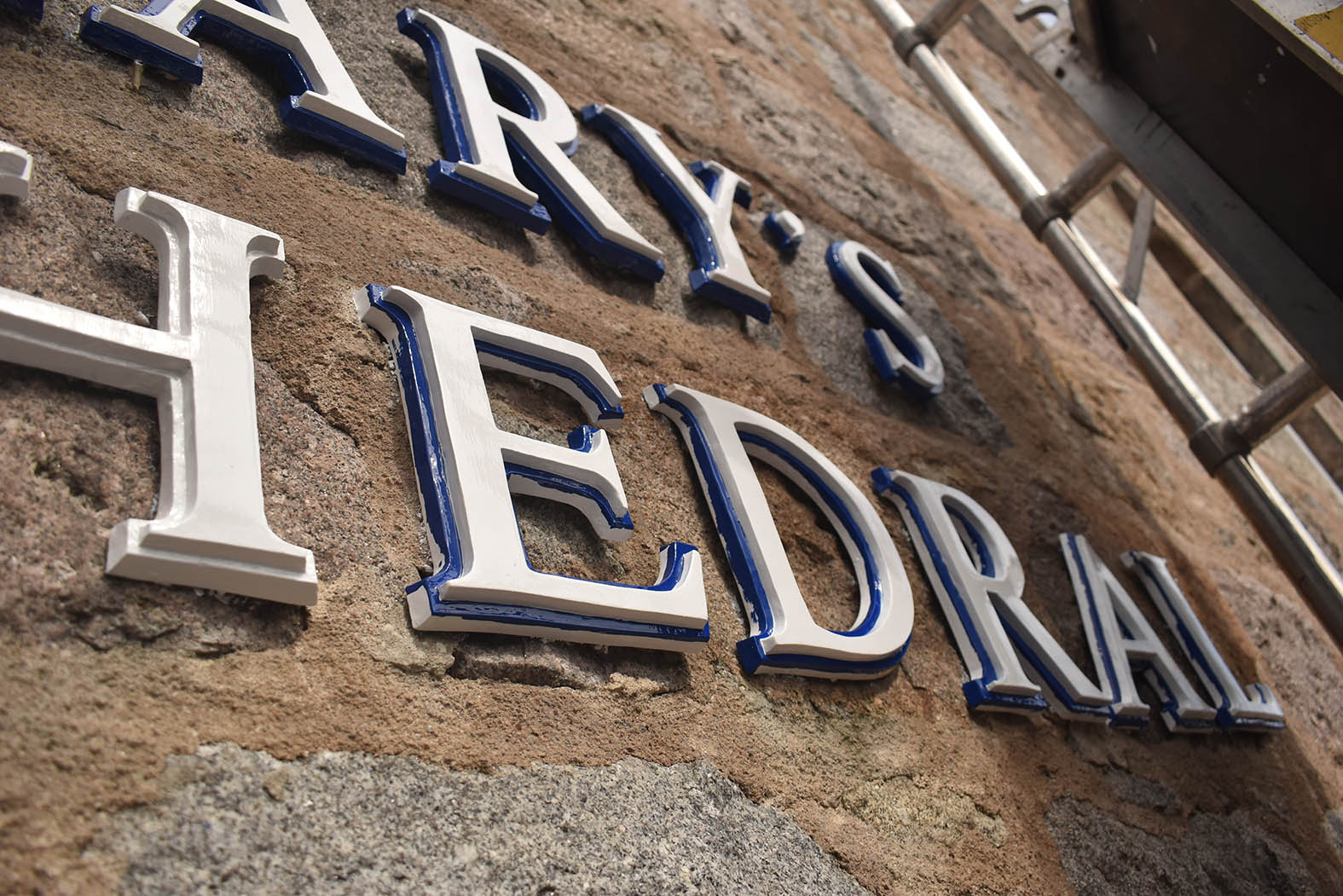
Although there were ninja showers throughout the five days of painting, I was able to dry the rain off the surfaces once the clouds had passed. Raindrops on wet enamel would be a disaster. I was praying for two fair days to paint the colour.
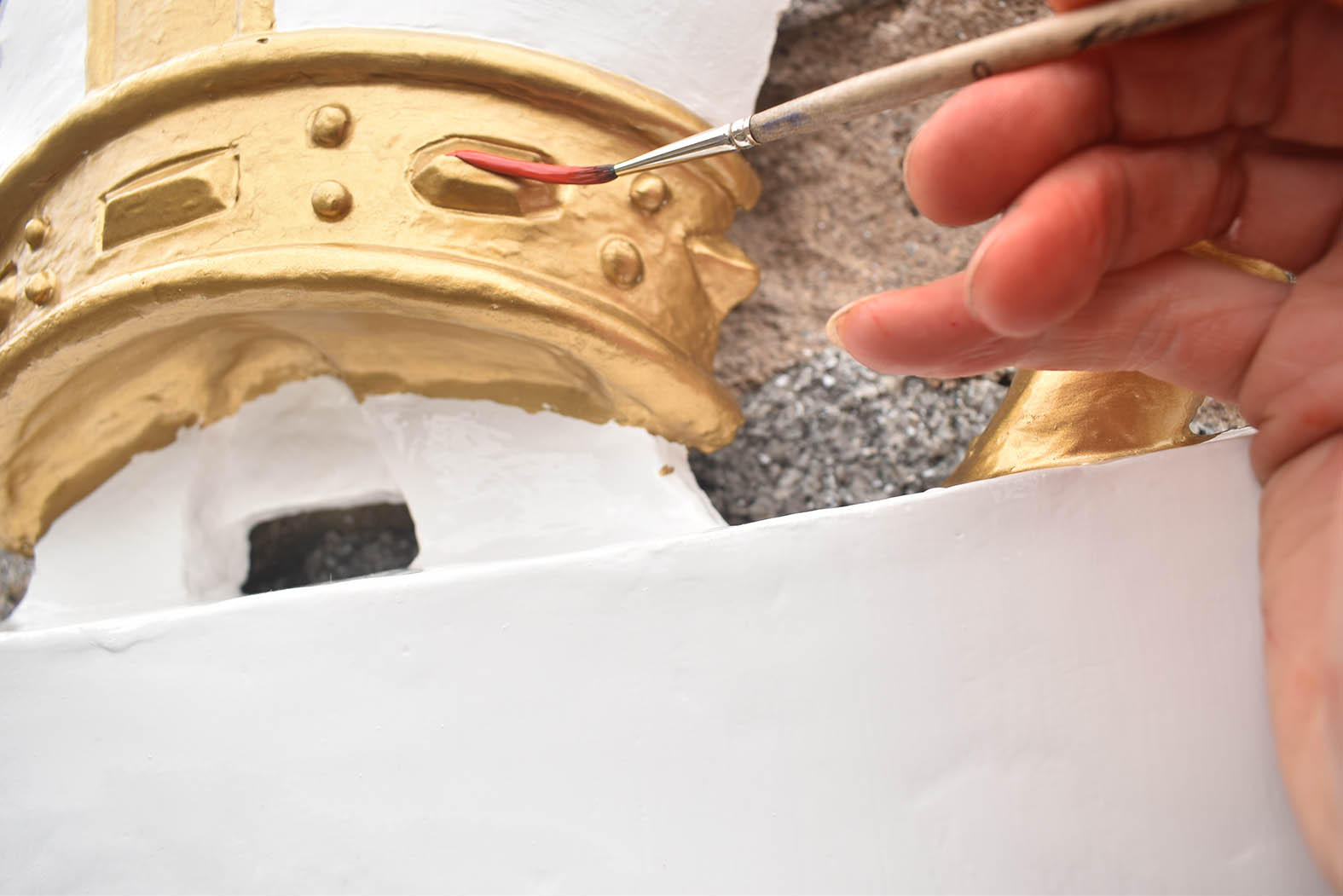
Beginning from the top, I coated metallic gold on the coat of arms and planned the red and deep blue before second coating the gold. Signwriters’ enamels were used throughout the top coats due to their fluidity and reasonably opaque coverage. I have a rough idea of overcoating times, and the sun was peeping through the clouds. I prepared for a long shift ahead.
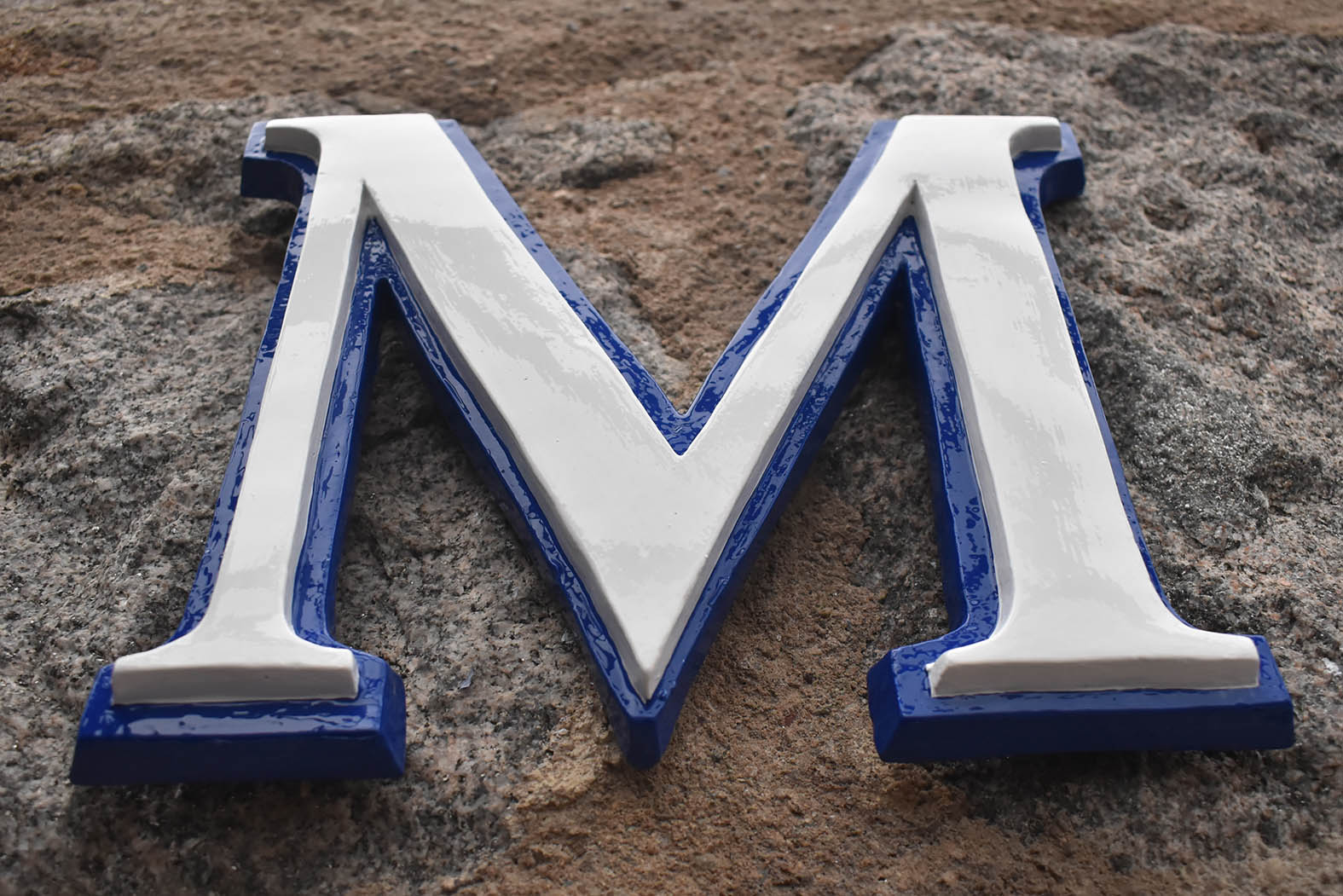
With much of the colour on the coat of arms and the deep blue outline on ‘St Mary’s’, I climbed off the scaffold around 8pm. It was a lovely evening in Aberdeen city centre, so I went for a stroll and looked for a restaurant.
The cathedral’s administrator is Father Keith Herrera who kindly hosted me that evening. I slept in the clergy house overnight to gain an early start on the fifth day of the restoration.
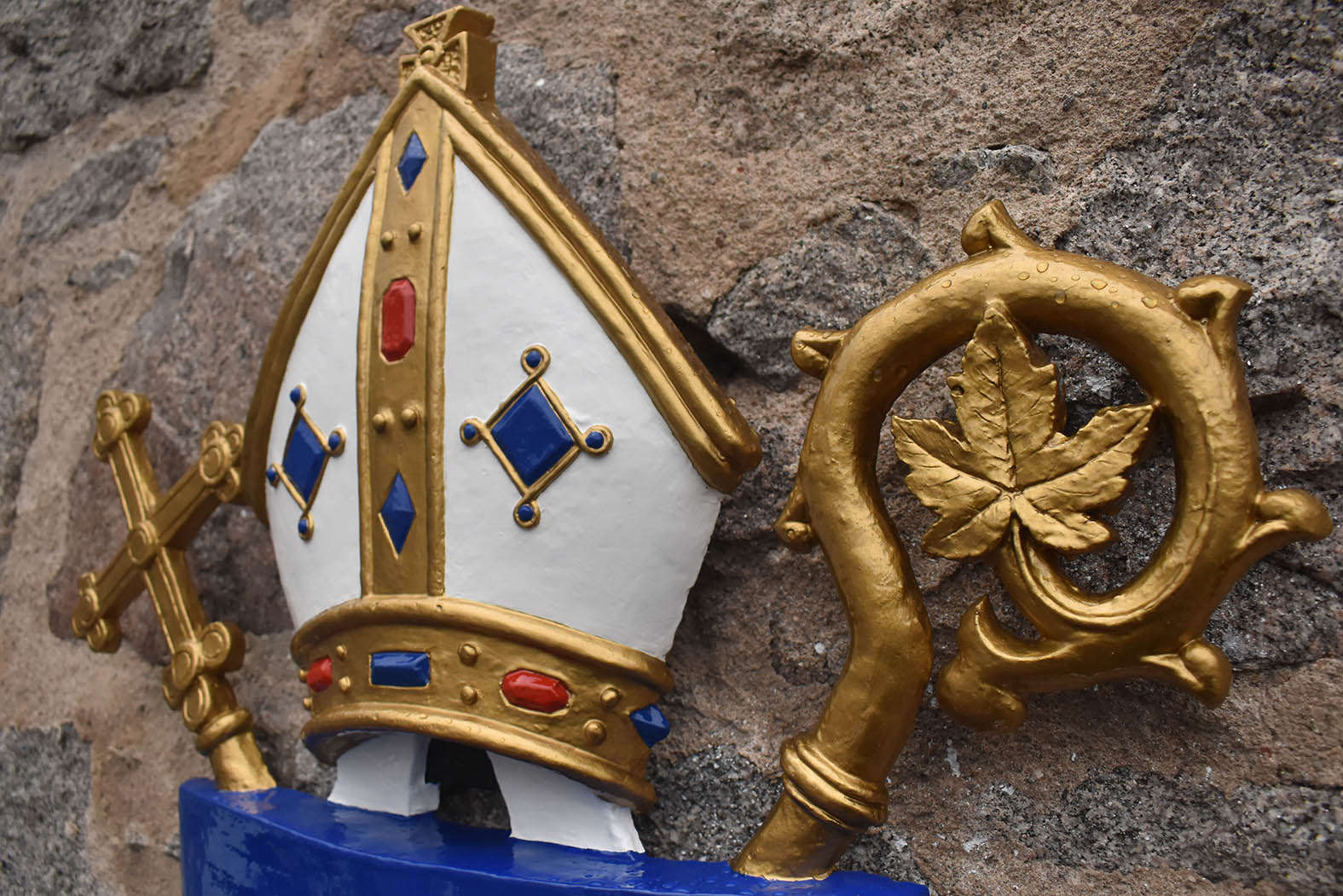
Around 5am, I climbed the scaffold to crack on second coating before painting the outline on ‘Cathedral’. It was drizzly and the sky was packed with clouds. I was concerned.
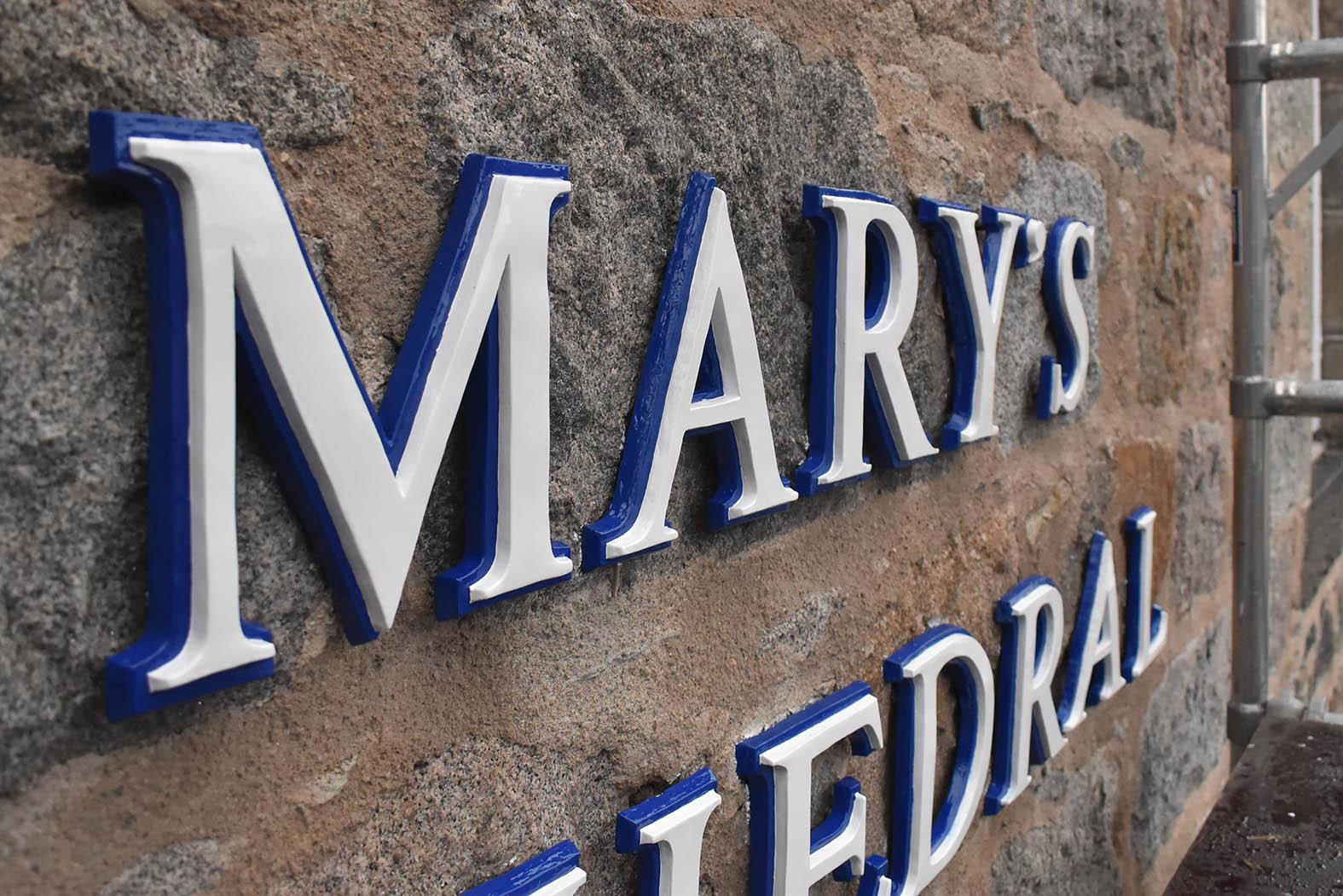
Fatigue was also looming. After five days of climbing up and down the scaffold tower, as well as repeatedly lifting the top platform off and on the scaffold rungs (I was standing and working at two different platform heights), I was tiring.
Through perseverance and with a bolt of motivation due to completing the coat of arms and a gradually clearing blue sky, my focus turned to the built ups. The deep blue was cut in tight to the edges of the protruding faces of ‘Cathedral’, careful not to dab paint onto the granite behind.
By around 5pm, the deep blue was completed, and again, I coated the faces of all the letters white for a clean, even finish. Hallelujah.
People were descending on the cathedral as I was climbing up and down the scaffold for the final time. Whilst carrying all my tools to my van and cleaning my brushes, I sensed a buzz in the atmosphere. That evening, a priest was being ordained inside the cathedral.
With the sun now shining on Aberdeen, well dressed folk of all ages and backgrounds walked in and around the cathedral. It was a marvelous moment to witness before driving back home.
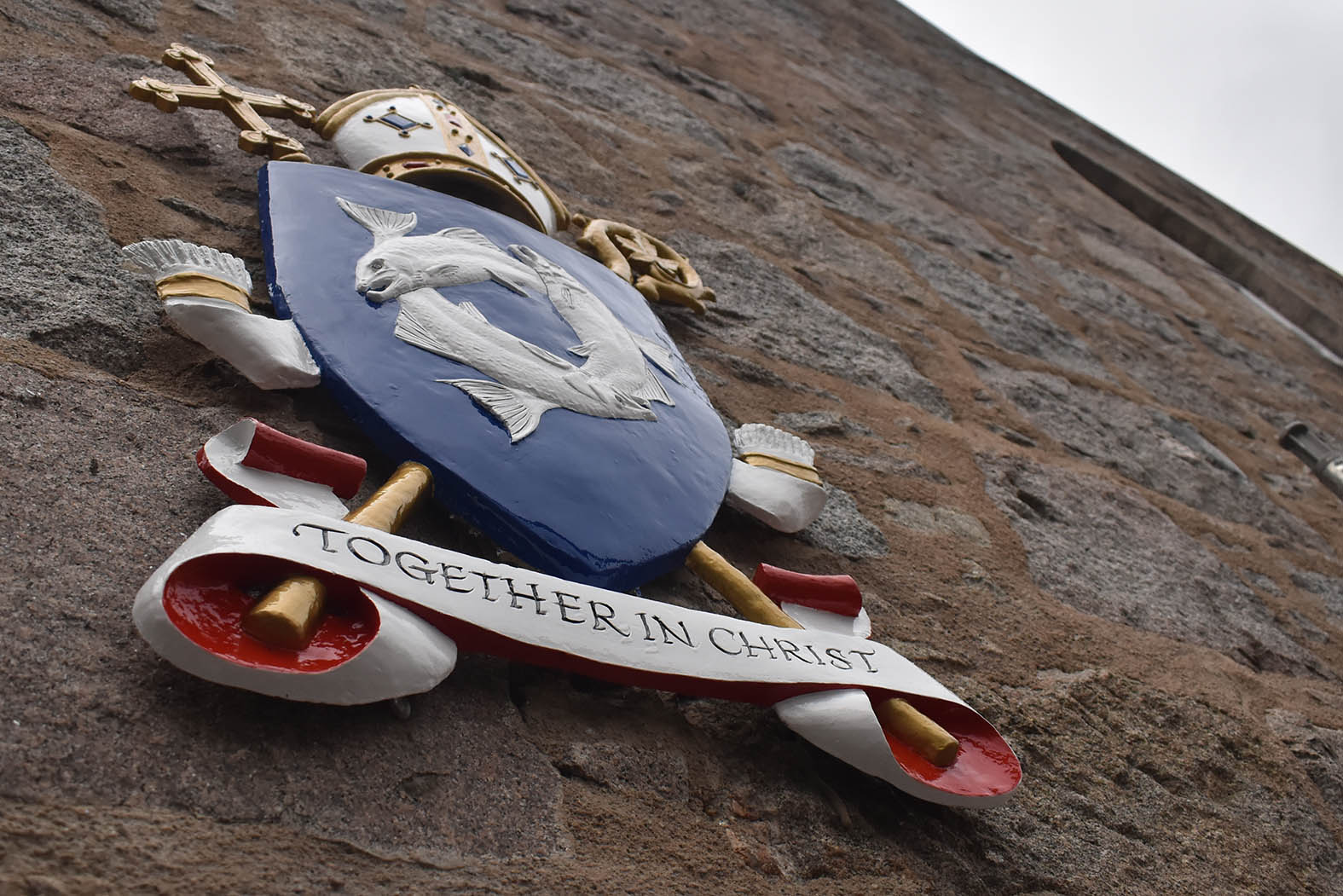
Towards the end of the paint restoration, I wondered why the coat of arms was centralised above ‘St Mary’s’, and ‘Cathedral’ was left aligned with ‘St Mary’s’. The two lines of built ups also appeared to be made from different alloys.
In conversation with Steven, he explained the cathedral wasn’t always a cathedral. We concluded, the ‘Cathedral’ built ups were an addition.
St Mary’s Cathedral houses beautiful works of art. It’s a special building, flowing with life and meaning. I learnt insight into how an historic place of worship operates in an increasingly fast, modern world. It was a pleasure.
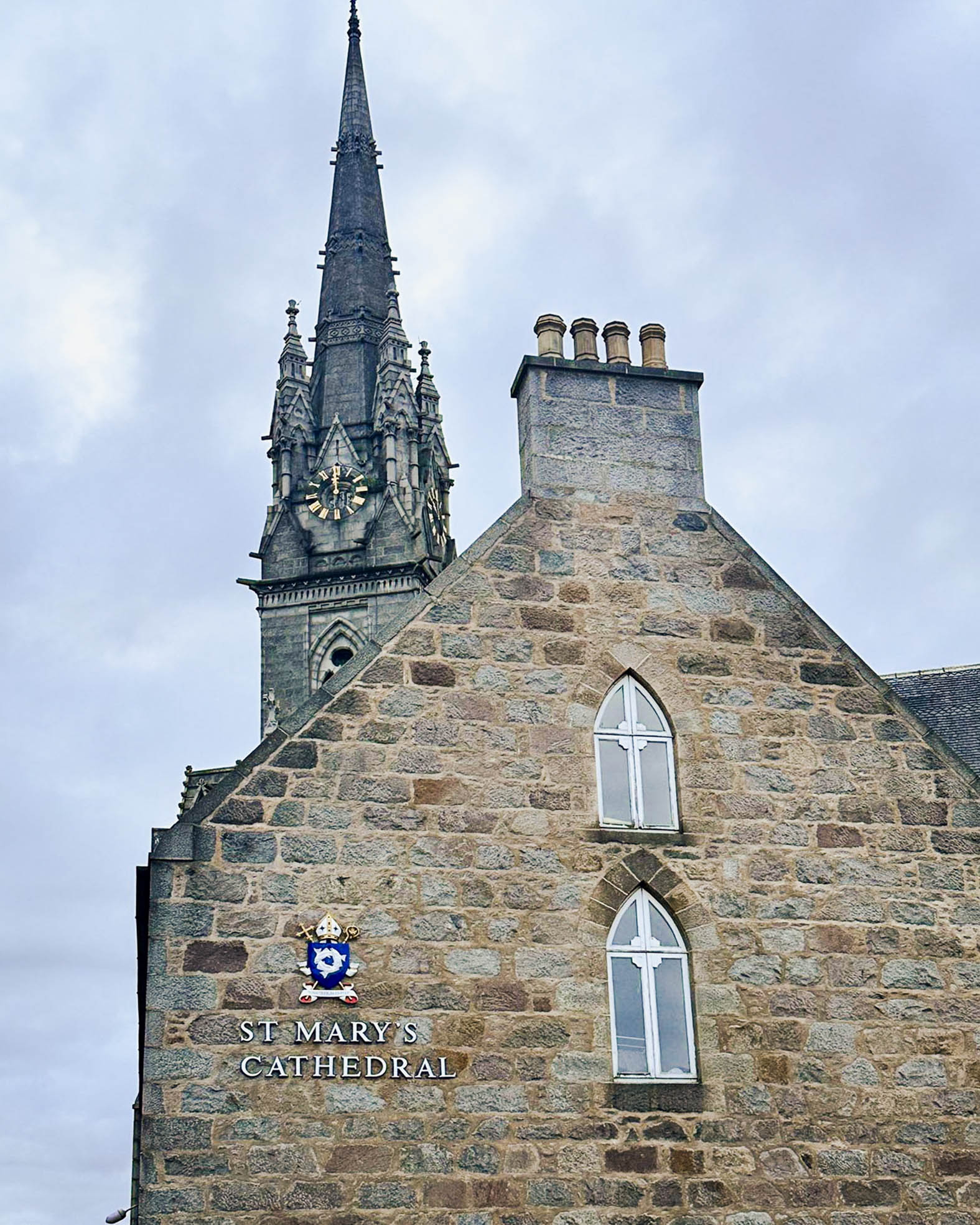
Steven was delighted with the result: ‘I arrived back in Aberdeen last night to see it in person. You’ve done an incredible job, I’m very impressed with how it’s come up.’
Searching for hand painted signs in Aberdeen? Get in touch to discuss.